Manual Calculadora Casio Fx-4000p En Castellano
Oportunidad en Manual Instrucciones Casio Fx 4000p! Calculadora Casio Fx95 Es Plus 274 Funciones $ 455 00. Oportunidad en Calculadora Casio Fx 500a Equation. Calculadora Cientifica Casio Equation Fx 95 Con Manual. How To Solve Matrix In Calculator Casio Fx 991es. You are here: Documents / How To Solve Matrix In Calculator Casio Fx 991es Related.
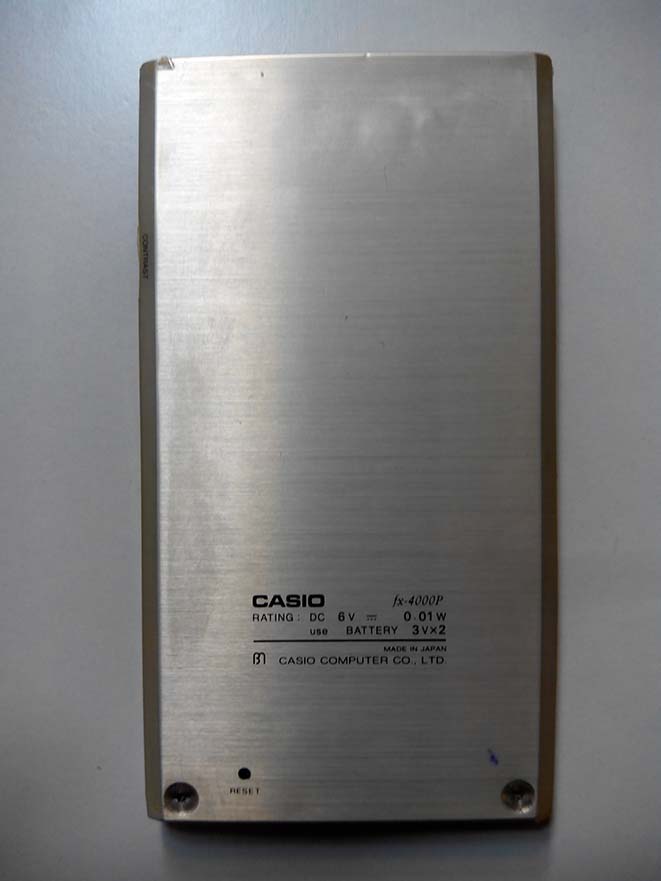
This small pocket calculator was manufactured in Japan after 1986 week 43 according to the most recent chip date found in the PCA of this specimen. The year is 1985. Casio released this model with an impressive set of features for its time: - Re-configurable RAM memory partitioning.
Default values are 26 x 8-byte registers and 550 programming steps. - Fully merged programming model. - Conditional and unconditional jumps, subroutines. - Support for indirect register addressing. - User friendly programming environment. Keystrokes displayed by its function names.
Easy editing and debugging. - Alphanumeric capability. Calculator forensics: arcsin(arccos(arctan(tan(cos(sin(9)))))) = 8.999686999 Remaining digits: 9 - Ans Exe x 10000000 = 31.3001 5x7 dot matrix LCD display, natural language algebraic input.
We identify these patterns by looking at the activity of millions of web users throughout the world, and using data normalization to correct for any biases. The more traffic a site gets, the more data we have to calculate estimated metrics. Bengalitvserial net star jalsha. Estimates are more reliable the closer a site is to being ranked #1. Global traffic ranks of 100,000+ are subject to large fluctuations and should be considered rough estimates.
Friendly program editor. Keystrokes displayed by its function names. Left and right cursors allows easy editing. Program memory usage updated in real time at the top right. Dot matrix LCD display with full contrast ON to show all elements. Accessing the battery compartment. It uses two CR2032 in series for a total of 6Volt at 1.7mA average current consumption.
(to be continued) Jose Mesquita. ( 08:42 AM)Tugdual Wrote: Compared to the recent hp made in China, the design of these old Casio is very impressive. I'd love to own one of these old Casio. Is it as robust as it looks like? Easy to open and clean?
These machines are robust and easy to clean, but the weakest point is the keyboard operation. The key travel is very short and mushy, nothing compared to what we expect from a proper genuine HP machine (or from the latest for that matter). On the positive side, the key registration is very reliable, contrary to what some recent HP calculators like the HP-30B are doing (despite a positive mechanical action, the registration is not always reliable, be it because there are quality control issues or any other reason). Jose Mesquita. Getdataback for ntfs 4.33 license. This is my hierarchy of preference for calculator keyboards: 1) Positive tactile action and reliable (my HP11C) 2) Mushy action and reliable (my Casios and Sumlock Anitas) 3) Positive tactile action and unreliable (my Texas TI59, HP30B, and Sinclair Scientific) 4) Mushy action and unreliable - quite rare, I think Ergonomically speaking, the worst keyboard I have is on my Novus Mathematician.
It provides no tactile feedback whatsoever and the spring rate is unpleasantly non-linear, giving the feeling that the key is about to snap off at the limit of its travel. However it responds reliably and doesn't generate double presses.
I think Texas scared quite a few customers off around about the time of the TI57 (and its numerous cousins rendered in similar hardware). Those were very poor units and, in the main, their leaky NiCads sent them to an early grave. The CASIO FX-4000P was a very good machine, you could keep 10 different programs into permanent memory, programs could call each other as subroutines, allowing to start in a given mode (typically the 'normal' mode), make some calculation in a different one (SD, LR, even Base-N for example), display/pause or wait for user input to continue, use loops to fill indexed arrays (memory was 2kb, allotable between up to 550 steps/26 memories and 0 steps/lots of memories). Display was alpha only (no graphics) but there was a large character set. The language was not BASIC but a cleverly designed one, offering much of what to expect from a programming language. There was a hack I stumbled on accidentally some day, allowing to have both 2000 steps and the max number of memory (simply said, the pointer to the end of the program area or the beginning of the memories area was set to an impossible value which gave 'god mode' and unprotected access to the whole memory from either perspective). Needless to say, you could be overwriting programs with the content of some memories, which unlocked hidden functions and characters such as percentages, imaginary numbers and probably more.
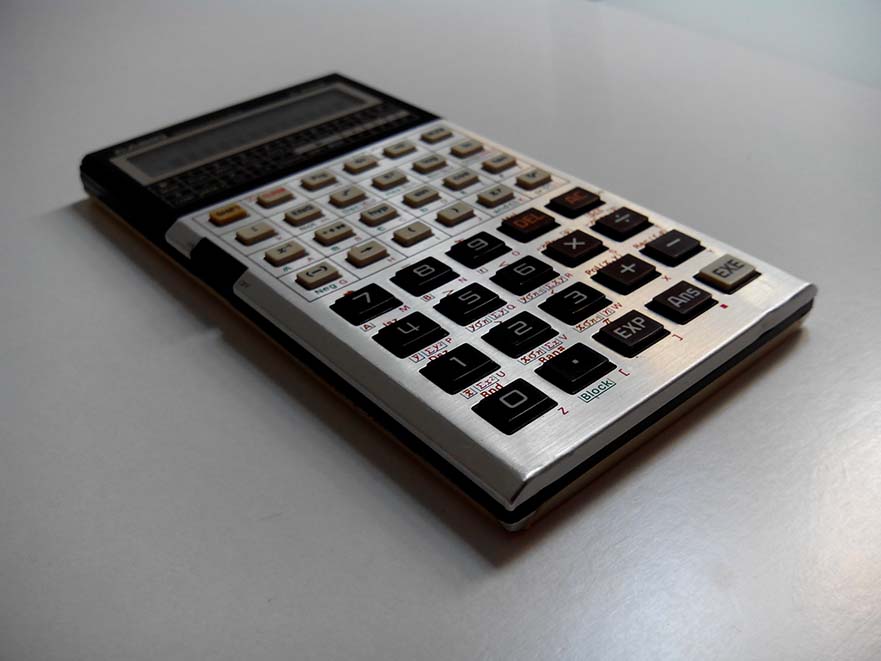
You could also very easily lose access to the already written programs, so this was to be handled with great caution. I used this small beastie a lot at the time, and the only things I could gripe upon were that I would have loved to have a few kb more memory, and some I/O to store/retrieve programs and data. The next models were a crippled version without a real programming language, just some 'function definition' capability, or buffed up versions with more memory and display lines, but more massive already, which made them less convenient to keep in a shirt pocket. Then the graphical calculators came, but they were too bulky and contained too much useless crapware for a comfortable use outside a classroom. The FX-4000P was an exceptional calculator by CASIO.